A Raised Hand or a Call: Two Ways to Share a Signal
Cricket signals make different things easy to notice: learn when a spoken call carries across the field and when a raised hand is easier to read.
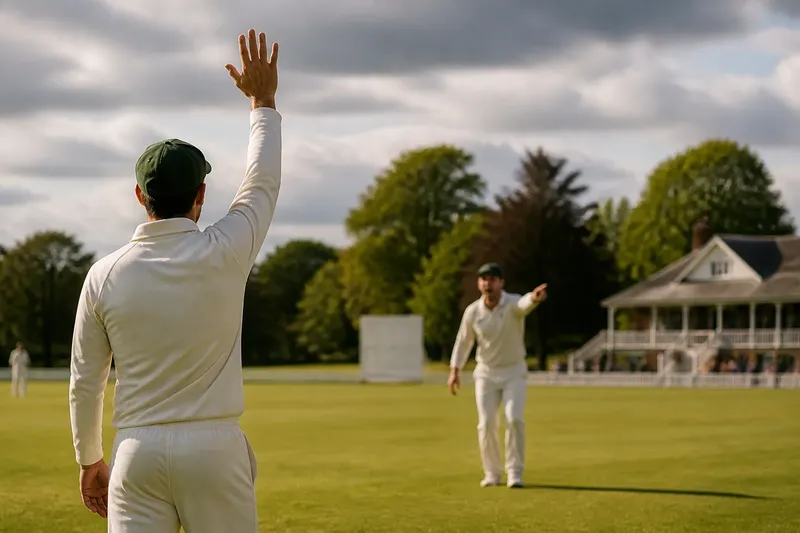
At a club ground, a fielder near the boundary lifts one hand while a teammate calls, “Yours!” beneath a gust of wind. The two signals carry the same practical message, but they reach different people in different ways. Cricket signals work best when their form suits the space, the attention available, and the person who needs to respond.
Cricket signals meet different kinds of attention
A spoken call travels through sound. It can reach a teammate who is looking elsewhere, provided the voice carries and the words are understood. A gesture travels through sight; it can be quiet, immediate, and clear to someone already watching, but it cannot reach a person whose view is blocked.
That distinction matters on a field with several moving players and changing lines of sight. A call can cut through the visual clutter of running bodies. A raised hand can stand out when voices overlap or the distance makes speech indistinct. Neither channel is inherently clearer. Each makes a different kind of attention easier to capture.
There is also a difference between noticing a signal and understanding it. A hand in the air is easy to spot, but its meaning may depend on the team’s shared habits. A short, familiar call can identify the intended action more precisely, yet only if the words arrive intact. Clarity comes from a signal that the receiver recognizes, not simply one that is loud or conspicuous.
Calls reach beyond the current line of sight
Speech is useful when a player must respond without looking toward the speaker. A fielder tracking the ball can keep attention on its flight while hearing a teammate claim the catch or direct a nearby player. In that moment, a call can make the next decision audible without requiring a glance away from the play.
Words also allow a little more detail. A name, a direction, or a short instruction can distinguish who should act and what they should do. On a close field, this can prevent two teammates from moving toward the same ball. The useful call is usually brief enough to grasp while the action continues; a long explanation asks too much of a listener who is already watching the ball.
Distance and surroundings can weaken that advantage. Wind, nearby voices, crowd noise, or the speaker’s position may blur a call. Even a familiar word can become ambiguous if only its ending reaches the listener. A player who cannot tell whether a teammate spoke should not have to guess at a consequential instruction.
Visible gestures stand out in a shared view
A raised hand is especially legible when players are already facing one another or scanning the same part of the field. It can mark a person’s presence, acknowledge a message, or indicate readiness without adding another voice to a busy moment. A clear gesture may also remain visible longer than a brief call remains audible.
Gestures have limits of their own. A low hand disappears behind grass, a body, or a sight screen; a player looking toward the batter may never see it. Bright clothing, changing light, and the distance between teammates can make a small movement harder to distinguish from ordinary repositioning. A gesture intended as a signal needs a shape that looks deliberate from where the receiver stands.
There is no need to make every gesture elaborate. A large, simple movement is generally easier to recognize than a sequence of subtle motions. What matters is whether teammates know what the movement means and can see it from the relevant positions. Unfamiliar signals create a small delay as the receiver tries to interpret them.
Choose the signal for the person who must notice it
Before choosing between a call and a gesture, consider the receiver rather than the sender. Is that teammate likely to be looking in the right direction? Is the distance short enough for ordinary speech? Would looking away from the ball create a problem? These questions point toward the channel that fits the moment.
- Use a concise call when the receiver may be looking elsewhere but can hear you.
- Use a visible hand signal when teammates share a clear view and speech would be lost in overlapping voices.
- Pair a familiar call with a gesture when the moment is crowded and the message needs to reach more than one person.
- Keep gestures simple and distinct from routine movements so they do not invite a second interpretation.
- Agree on the meaning of less familiar signals before play, rather than relying on teammates to infer it during action.
Suppose a fielder near the boundary expects a teammate at midwicket to signal that the ball is coming into the gap. They agree beforehand that the teammate will point toward the boundary and call the fielder’s name. If the fielder is watching the batter and misses the point, the name may still draw attention; if the voice is swallowed by nearby chatter, the gesture may still be visible. The expected result is a clearer chance to register the message, not certainty that it will be noticed.
Some signals deserve a second channel
When the cost of misunderstanding is small, one clear signal may be enough. When several players could reasonably act on the same message, combining speech and gesture can help identify both the intended person and the direction of action. The channels complement each other because one can remain available when the other is missed.
Doubling every message, however, is not worth the effort. Constant shouting and waving can make ordinary movement look urgent, while adding noise to a field where players already know their roles. Save the second channel for moments when the receiver’s attention is uncertain or the message matters to more than one teammate.
Teams also benefit from noticing what happens after a signal: does the intended player turn, respond, or continue as before? That visible response helps the sender tell whether the message landed. If it did not, a brief repeat in the other channel is more useful than assuming silence means agreement.
Which signal fits the moment?
When is a call easier to notice?
A call helps when the receiver’s eyes are occupied but the voice can carry. Keep it short and use words teammates already recognize.
When is a hand signal clearer?
A gesture suits a shared sightline, especially when voices are competing or a quiet acknowledgment is enough. Make the movement visible from the receiver’s position.
Should spoken calls and gestures be used together?
Use both when the message needs extra reach or several players may need to respond. If the meaning is simple and the receiver is clearly attentive, one channel can be tidier.
What if the signal is missed?
Repeat it plainly, using the other channel if that is more likely to reach the teammate. A visible response is a better sign of understanding than silence.
Small acknowledgments complete the exchange
A signal is not only an act of sending; it is an attempt to establish shared understanding. The receiver’s nod, answering call, or change of position can close the loop without turning a routine moment into a conversation. On a busy field, that small acknowledgment helps teammates know whether to carry on or try again.
For a reader watching from the boundary, the same distinction makes field communication easier to follow. Notice who can see whom, whether a call appears aimed at a particular player, and what response follows. Cricket signals become legible not as isolated sounds or movements, but as a brief exchange between people sharing the field.